
A fresh chance opens up now – health workers can apply for dozens of roles just posted in Lahore. From what appeared in the Express Tribune on 25 February 2026, these openings come through the Health & Population Department, guided by the DG Health Services Punjab. Instead of waiting around, doctors might step into consultant and specialist spots across city hospitals. While some look elsewhere, many could find this a solid move within Pakistan’s public health system. Behind it all stands one of the province’s key medical authorities, shaping careers without fanfare.
Health and Population Department Punjab Overview’s
A key player in Punjab’s well-being is the Health & Population Department, shaping how care reaches people throughout the region. Running city clinics, countryside outposts, specialty wards, plus disease prevention efforts falls under its watch. Since more individuals live here than any other area in Pakistan, skilled doctors and nurses are needed now more than ever. Filling new posts often happens because health demands keep rising alongside the numbers of residents.
A fresh ad campaign from 2026 shows how firmly the government stands behind upgrading medical expertise in Lahore along with surrounding areas. Instead of settling for average talent, they’re bringing in seasoned doctors to strengthen treatment quality while easing pressure on hospitals – effectiveness becomes clearer when skilled hands guide each step forward.
Available Medical Jobs Overview
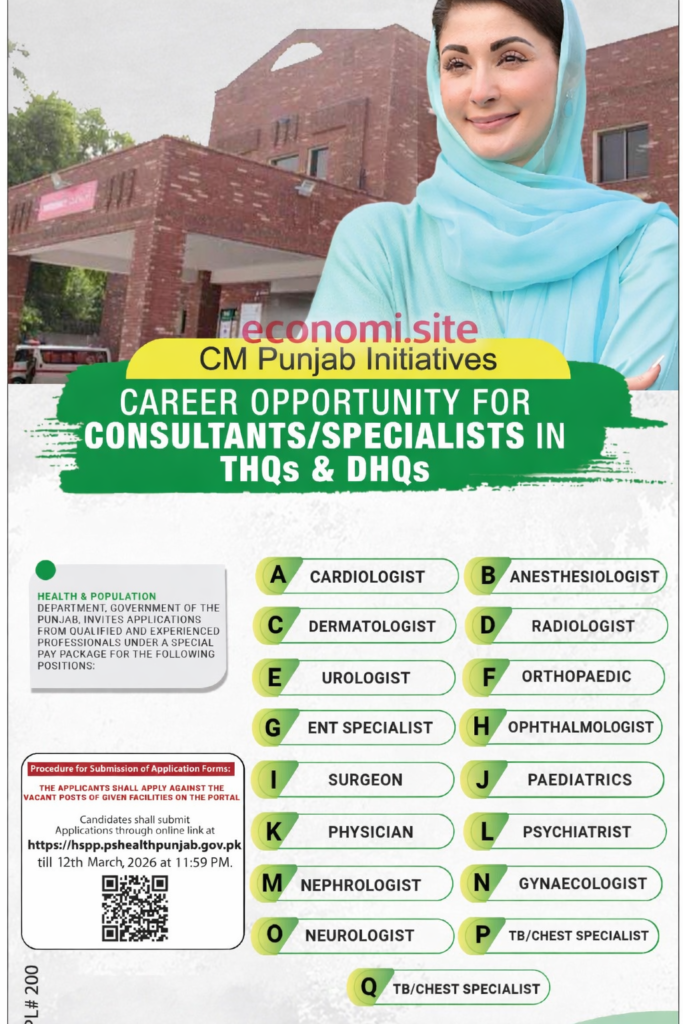
A wide range of expert jobs is shown in the ad, signaling attention to full medical support across areas. Roles open right now feature:
Psychiatrist
Nephrologist
Paediatrics Specialist
Cardiologist
Radiologist
TB Specialist
Physician
Ophthalmologist
Chest Specialist
Dermatologist
Surgeon
Consultant Orthopaedic Surgeon
ENT Specialist
Neurologist
Gynaecologist
Urologist
Orthopedic Surgeon
Anesthesiologist
Most areas of today’s medical work are covered here, starting with basic care then moving into focused surgery or testing roles. Not every field is identical, yet each finds a place within these opportunities, whether hands-on or behind the scenes in analysis.
Nephrology
Nephrologists handle problems tied to the kidneys – things like long-term damage, cleaning treatments, or care after a transplant. Because more people face blood sugar issues and high pressure in vessels, trouble with kidneys shows up often now, creating greater demand for trained specialists.
Paediatrics
Little ones need doctors who know just how their bodies work. From shots that prevent sickness to watching how fast they grow, these experts guide the way. When bugs spread at school or milestones come late, help shows up. A stronger team means fewer young lives lost along the path. Their presence change’s what happens when thing’s go wrong.
Cardiology
Heart problems like clogged arteries, weak pumping, or irregular beat’s fall under what cardiologist’s handle. Because conditions tied to the heart rank high in global fatalities – especially seen across Pakistan – care focused on these issues becomes necessary.
Radiology
Out of every hospital scan, radiologists are the ones who make sense of X-rays, CTs, MRIs – also those ultrasound images. When doctors need to understand what is going on inside, these specialists help point the way through careful analysis.
TB Specialist
Still today, tuberculosis weighs heavily on Pakistan’s health system. Doctors who study TB work to spot cases early, slow how it moves through communities, while helping government efforts to keep infections down.
General Physician
From the first exam to ongoing treatment, doctors handle countless health issues head on. When complex problems arise, they link patients with experts who can help. Their role keeps things moving behind the scenes, guiding each step without missing details. Not every case stays in house – some need a different kind of attention.
Ophthalmology
When eyes struggle, doctors step in – cataracts, pressure buildup, torn layers inside. Seeing better means living fully, working steadily. From blurs to clarity, relief reshapes days.
Dermatology
Folks who handle rashes, scalp issues, and brittle nails often work under dermatology. In Pakistan, things like dust, heat, or pollution tend to spark up reactions – ranging from itchiness to full-blown flare-ups – more than you’d think.
ENT Specialist
From time to time, doctors focused on ears, noses, and throats handle issues like clogged sinuses or trouble with hearing. These experts also look into problems affecting the throat area. When something feels off in the head or neck region, they step in too. Their work covers a range of conditions beyond just one spot.
Neurology
Doctors who study the brain handle problems like seizures, issues after a stroke, also movement troubles tied to Parkinson’s. Nerves throughout the body fall under their care too.
Gynaecology
Women see gynaecologists for help with their reproductive health. These doctors guide them through pregnancy checkups. Childbirth is handled by these specialists too. When issues arise in the female system, they offer treatments. Problems tied to organs like the uterus or ovaries fall under their care.
Educational Requirement’s and Eligibility Criteria’s
A degree listed first in the job notice is usually an MBBS, along with any related credentials that fit the role. Holding a medical diploma from an approved school matters most for applicants. When it comes to expert jobs, extra training after graduation – like FCPS, MD, or MS – might be needed, though what counts can shift with each opening.
Getting listed with the Pakistan Medical and Dental Council – or whatever body oversees doctors where you are – is usually a must. Most times, having worked in that specific area helps, particularly if it’s a senior doctor role.
Government Medical Jobs in Punjab?
Government medical jobs offer several advantages:
Predictable paychecks come with working for the state. Staying in one role for years is common when hired into public service.
Paid fairly, following state guidelines for wages. Money matches public sector standards.
Medical staff get help with housing costs, health coverage, sometimes a retirement package too. A place to live might come included, care when sick is covered, future income secured later on.
Finding new ways to learn comes through classes that build skills. Workshops open doors without promising too much. Moving ahead at a job often follows steady effort. Learning happens step by step, not all at once.
Health of communities often shifts when doctors step in. Their work shapes how well people live, one choice at a time. Outcomes rise quietly under steady care.
Doctors find themselves treating varied populations when working within the Health & Population Department. Exposure to many different medical situations comes naturally through such roles.
Application Process
Those looking into the role should go through the full ad printed in the paper. Submissions need to arrive by the deadline – likely around March 12, 2026 – though the exact day will match what’s stated in the original notice.
Applicant’s typically need to..
A filled-out application form must be handed in
Attach copies of educational certificates
Provide experience certificates
Include CNIC copy
Attach recent passport-sized photographs
Failing to get your papers approved on time might mean they won’t be accepted at all. One late stamp could be enough to rule you out completely.
Sending things ahead of time makes sense, just in case surprises pop up later.
The Importance of These Openings in Lahore
Lahore holds big public hospitals because it is Punjab’s main city. With new expert doctors joining, treatment quality should rise across top-level medical centers and training schools.
Fewer empty hospital beds happen when expert teams grow. Because cities fill up, doctors need support. When clinics boost their skills, patients get seen faster. Since emergencies rise, strong units respond better. As people age, trained staff make care smoother. With more folks needing help, focused training matters most
Reduced patient waiting times
Improved diagnostic accuracy
Better emergency response
Enhanced surgical services
Contributing to Better Publics Health
A fresh hiring push shows how seriously officials are taking upgrades to public medical services. With trained workers joining, efforts gain strength – fewer illnesses spread, city and countryside access grows fairer, progress on nationwide plans moves quicker.
The Career Growth and Professional Developments
Medical professionals joining the department can expect opportunities for:
Participation in medical conferences
Government sponsored training program’s
Research collaboration
Working as an instructor at connected schools
Administrative leadership positions
Supervisory jobs in hospitals sometimes come into view after landing consultant positions.
Conclusion
A chance opens in 2026 for skilled health workers through a Punjab government notice from the Health & Population Department based in Lahore. Held together by real need, roles span fields like heart care, kidney treatment, mental health, operations, among others. Strong candidates step into respected posts, part of an effort to lift community medicine higher. Commitment matters just as much as credentials here. Opportunities form slowly when talent meets purpose within public service.
Those looking to join who hold an MBBS plus further medical training must go through the official notice closely – apply by March 2026 at the latest. Stability in work life shows up here, along with solid pay, yet beyond that lies real chance: helping people across Punjab’s health system in ways that stick.
Starting out in public health? This hiring push in 2026 opens real opportunities for doctors wanting stable roles. Instead of private practice, some now see value in serving through government positions. Progress isn’t always loud – sometimes it arrives quietly through job postings. Steady growth shows up where systems invest in skilled workers. A chance appears when openings align with purpose. Year after year, service shapes careers just as much as clinics do.